
Living longer, retiring differently: What the next 40 years mean for your wealth.

Retirement planning has always involved uncertainty. What is changing is how long your plan may need to work, and how many financial decisions need to stay aligned along the way.
The Australian Government’s 2026 Intergenerational Report looks ahead to 2065-66. It points to longer lives, a larger role for superannuation in funding retirement and growing questions about how wealth and opportunity are shared between generations. The report paints a national picture, but the questions it raises are personal. How long might your savings need to support you? How much flexibility will you want later in life? What role do you want your wealth to play for your family?
If you are approaching or already in retirement, the question is no longer simply whether you have accumulated enough. It is whether your superannuation, investments, cash flow, tax structures, property, estate planning and family objectives are working together in a way that supports the life you want.
Strategic advice can help bring those decisions together: what to do now, what can wait, which assets should fund spending, what should remain invested, and how much flexibility to preserve for health, family or opportunities you cannot yet predict. It can also help answer a question many families eventually face: how can I help my children without compromising my own security?
A longer retirement changes the job of your savings
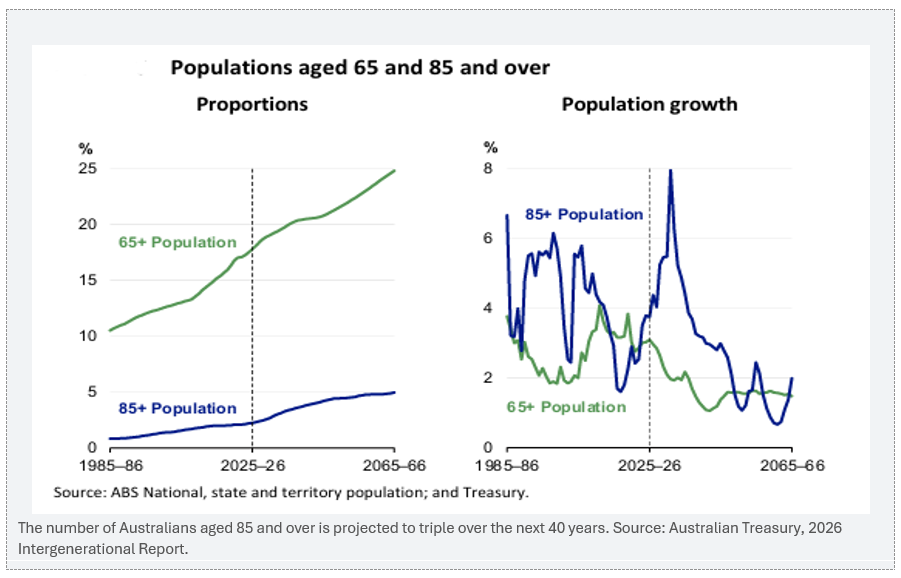
Treasury projects that the number of Australians aged 85 and over will triple over the next 40 years. For someone retiring at 60 or 65, that reinforces a practical reality: your savings may need to support your lifestyle, withstand market cycles and inflation, remain available for major expenses and later-life care, and perhaps also provide support for your family for longer than has been the case in previous generations.
It is useful to think about your savings in terms of purpose rather than as one pool of money. The money you expect to spend over the next two years has a different job from money you will rely on in 15 or 20 years.
Average life expectancy should not be treated as an expiry date. A robust plan needs to remain workable if you or your partner live materially longer than expected, if one of you needs care the other cannot provide alone, or if your spending looks different from what you first assumed.
Scenario modelling can test that resilience. What happens if retirement starts earlier, spending is higher in the first decade, markets are weak early in retirement, or one partner requires significant care later? The purpose is not to predict which scenario will occur, but to understand how much room you have to adapt.
Superannuation is moving from accumulation to retirement income
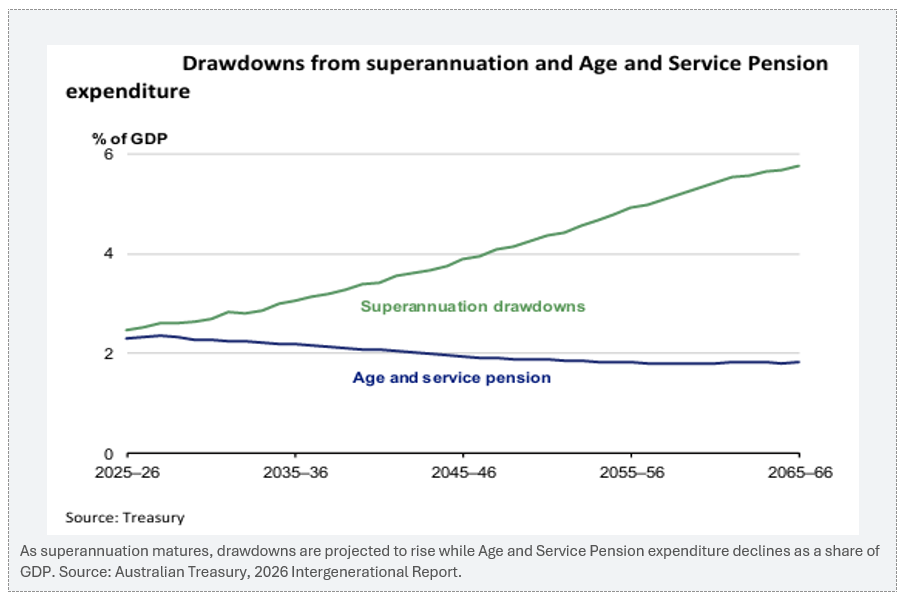
Australia’s superannuation system is entering a different phase. Treasury projects that the number of Australians above Age Pension age will almost double to around nine million by 2066, while the share receiving a pension or other income-support payment falls from 66 per cent to 52 per cent. Superannuation drawdowns are projected to roughly double to around 6 per cent of GDP.
That means greater responsibility for you in deciding how retirement savings are used, not simply how they are accumulated. For affluent families, superannuation may sit alongside personally owned investments, companies, trusts, property, business interests and cash. Your retirement outcome can depend as much on how those different pools work together as on the return from any one portfolio.
The timing of contributions, pension commencement, asset sales, capital gains, debt reduction and withdrawals can all affect the result. So can the structure in which an investment is held and the order in which different assets fund spending. A decision that is efficient this year may reduce flexibility later or create an estate outcome you did not intend.
These are not separate superannuation, tax and investment decisions. They are parts of the same retirement strategy, and the timing of one can change the value of another.
Investment, spending and later life needs should work together
Retirement does not eliminate investment risk. It changes its consequences.
At retirement you may still have a 20 or 30 year investment horizon, so moving too heavily into cash and defensive assets can leave purchasing power exposed to inflation. At the same time, a major market fall early in retirement can be particularly damaging if you need to sell investments to fund your current lifestyle.
Protecting enough near-term cash can reduce the need to sell longer-term assets at an inconvenient time, while leaving part of your portfolio invested for needs that may still be many years away. Your spending is also unlikely to move in a straight line. Travel, home improvements, major purchases and helping children may feature more heavily in some years, while health, support and aged-care costs may matter more later.
A plan that can adapt to those stages can give you greater confidence to use your money when it is most valuable to you, while still planning for what may be needed later.
How much capital should remain readily accessible? Would a significant health or care expense force an asset sale at an inconvenient time? If one partner needs care and the other remains at home, are your arrangements flexible enough? Are powers of attorney, estate arrangements and ownership structures still appropriate?
These questions are usually easier to deal with while you still have choices, rather than when a decision has become urgent or the timing emotional.
Family wealth is increasingly an intergenerational decision
Longer lives can mean family wealth remains with one generation for longer, while children and grandchildren may face some of their largest financial commitments much earlier.
The 2026 report gives unusual attention to intergenerational equity, including the difficulty younger Australians face accessing housing and the changing tax burden across generations. Treasury also projects real per capita gross national income to be 55 per cent higher by 2065-66. The future is therefore not simply a story of younger generations being worse off. Their path to financial security may, however, look different from the one experienced by many of their parents and grandparents.
For families with accumulated wealth, that raises a very personal question: when is family wealth likely to be most useful?
An inheritance received in a child’s late 50s or 60s may strengthen retirement. The same amount provided earlier might help with a home, education, a business or the costs of raising a family. Earlier assistance is not automatically better. Your own financial security comes first, and transferring your wealth can have tax, control, asset-protection and family consequences.
The important decision is the form, timing and purpose of the support. A gift, a documented family loan, an investment, assistance with a property purchase or provision through an estate can lead to very different outcomes.
There is also a difference between transferring wealth and preparing someone to manage it. Transferring wealth is a financial event. Preparing someone to manage wealth takes time. It can involve building financial capability, explaining the purpose of family structures and involving adult children in appropriate discussions. An estate plan can transfer ownership, but it cannot by itself transfer the judgement and confidence that develop through experience.
For some families, the better approach may combine financial support with gradual involvement and education. Capital intended for children or grandchildren may also have a much longer investment horizon than money needed for your own near-term spending. Its purpose can help determine how it should be invested and structured.
A longer horizon makes coordination more valuable
No 40-year projection will unfold exactly as expected. The Intergenerational Report highlights forces already reshaping retirement and family wealth: longer lives, a maturing superannuation system, greater later-life care needs and changing circumstances across generations.
A long retirement will inevitably contain surprises. A well-coordinated strategy gives you a framework for making decisions as they arise, while preserving flexibility for your own life and for the people you care about.
Perhaps the most useful question is not whether your plan works today, but whether it is flexible enough for the decisions that may come next.
Sources: Australian Treasury, 2026 Intergenerational Report, 21 September 2026; Treasury Ministers, Address to the Super Members Council Super Summit, 9 September 2026.